



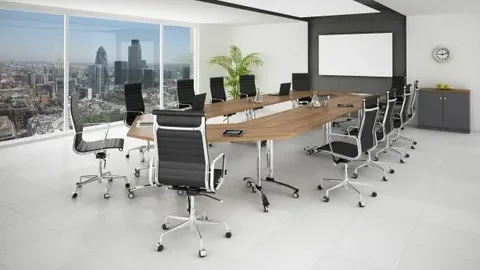
Most business owners think about office furniture in purely functional terms: you need desks, you need chairs, you need storage, so you buy those things and move on. But the businesses that actually get the most out of their workspaces understand that thoughtful office furniture design is not just about filling a room with places to sit. It is about creating an environment that actively supports the kind of work your people do every single day, and that distinction makes an enormous practical difference.
When furniture is selected and arranged with intention with the actual workflow, collaboration patterns, and individual needs of the team in mind, the entire office performs better. Meetings happen more fluidly, focused work is easier to sustain, and people move through the day without constantly working around a space that was not designed for them. When it is treated as an afterthought, the opposite tends to be true.
Designing for the Work That Actually Happens
Different types of work require different physical environments, and good furniture design accounts for these factors from the start. A team that spends most of its day on collaborative projects needs open-format tables, writable surfaces, easily reconfigurable seating, and casual gathering spaces woven throughout the floor plan. A team doing deep individual work needs acoustic separation, private-friendly workstations, and a layout that minimizes visual distraction. Most real offices need both, which means the furniture design has to be sophisticated enough to support multiple modes of working within the same footprint.
Research on focus-oriented office environments, like the insights published by MIT Sloan Management Review, underscores the fact that the physical configuration of a workspace, including furniture type, placement, and scale, has a direct impact on the ability of employees to transition between concentrated individual work and group collaboration without losing momentum or mental energy.
Furniture Communicates Your Brand
The furniture in your office is one of the most immediate expressions of your company’s identity, visible to every client, partner, and prospective employee who walks through the door. A law firm, a tech startup, a creative agency, and a financial services firm all communicate very different things about their culture and values through the way their workspaces look and feel, and furniture is central to that impression. Consistent, well-considered furniture design creates an environment that feels intentional and professional, while a mismatched or purely utilitarian approach can undermine the impression you are trying to make.
Office design experts covering the latest trends, including the editorial team at Fast Company’s office design section, consistently emphasize that the most effective workspaces tie furniture selection directly to brand identity, using materials, colors, and layouts that reinforce the company’s culture rather than working against it. This is not about spending more; it is about choosing with intention.Flexibility Is the Most Future-Proof Investment
One of the most valuable qualities in well-designed office furniture is adaptability. Teams grow, shrink, shift between departments, and change how they work over time. Furniture that locks a space into a single rigid configuration will require costly replacement or renovation as the organization evolves. Modular systems, reconfigurable components, and pieces designed to serve multiple functions within a space protect your investment over the long term while giving your team the ability to shape their environment as their needs change.
Getting office furniture design right from the beginning is not a luxury reserved for large corporations. It is a practical, high-return decision that any business of any size can make, and the benefits show up in productivity, culture, and the daily quality of work life for everyone in the space.