



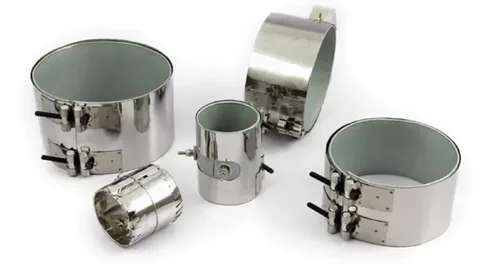
Buying a mica band heater might seem like a simple task, but there’s more to it than size and wattage. If you’re working in extrusion, every detail matters—from how evenly heat is applied to how easily you can maintain the unit. Here’s a breakdown of key things you should absolutely double-check before placing that order, especially if you’re aiming for long-term efficiency and smooth production.
Essential Clearance Verification for Uniform Thermal Expansion
The space between the heater and the barrel might look small, but it plays a huge role in how your mica band heater performs. This clearance allows for proper thermal expansion, which keeps the heater tight against the barrel during operation. Without that tiny allowance, the heater could face uneven contact, leading to temperature swings that affect extrusion consistency.
Overlooking clearance can cause premature band failure. As metal heats, it expands—if there’s not enough room, the band can warp or crack. Verifying clearance helps maintain a snug fit and even heat distribution, preventing cold spots that might ruin your final product. Uniform expansion across the barrel means the mica band delivers consistent heat, and that consistency is key in high-precision extrusion setups.
What Makes Internal Sheath Construction Critical for Heater Reliability
Inside a mica band, the sheath is the protective armor for the resistance wire. A poorly designed sheath won’t just underperform—it can fail under stress, especially in high-temp environments like extrusion. Stainless steel sheaths are common, but the thickness, grade, and insulation layer all affect durability and longevity.
If you’re working with plastics or polymers that require higher extrusion temps, internal construction becomes even more important. A strong mica insulation layer must separate the wire from the sheath without degrading over time. If this layer breaks down, you’ll see short circuits or cold zones. This is why understanding the build quality—not just the materials—matters when buying a mica band.
Band Heater Mounting Clamp Compatibility Checkpoints
Securing your heater correctly is about more than tightening a screw. The mounting clamp type must match your barrel’s geometry to prevent shifting or uneven compression. There are different clamp styles like barrel-nut, spring-loaded, and wedge-lock. Each one behaves differently under thermal cycling and affects how evenly pressure is applied.
Clamp mismatch can result in gapping, which reduces thermal transfer. It can also loosen over time, especially if the heater’s expansion doesn’t match that of the barrel. Before purchase, always confirm your clamp style and dimensions to ensure the mica band seats firmly. Good compression equals better heat transfer and less downtime from adjustments.
Reasons Terminal Box Orientation Impacts Maintenance Efficiency
Terminal box orientation might not be the first thing you think about, but it directly affects your maintenance workflow. Depending on where your machine is positioned, the terminal box location could either make connections easier or turn them into a cramped headache. A poorly placed terminal box can also expose wires to unnecessary heat or physical damage.
Choose an orientation that allows for easy access and cable routing. This small step saves time during installation and avoids costly mistakes down the road. You’ll thank yourself later when you don’t need to disassemble half the machine just to check a wire or replace a terminal. It’s one of those details that quietly pays off over the life of your mica band heater.
Confirming Heater Lead Insulation Meets Extrusion Temperature Demands
The lead wires extending from the mica band face high temperatures and mechanical stress. If their insulation isn’t rated for your extrusion environment, you’re asking for failures. Fiberglass leads are common, but for high-temp zones, you may need extra shielding like stainless braid or even Teflon coatings to prevent breakdown.
It’s not just about temperature, either. Leads near moving parts need extra durability to prevent fraying. Make sure the lead length, exit style, and insulation type all match your equipment needs. These small elements protect against unexpected shutdowns caused by exposed wires or insulation fatigue. It’s worth the time to match insulation specs with real-world conditions.
What Are the Ways Heater Surface Loading Influences Extrusion Quality
Surface loading, or watt density, tells you how much heat energy is applied per square inch of the band. If this number is too high for your application, it can burn out the mica insulation or overheat your barrel. Too low, and you won’t get enough heat for your process, leading to uneven extrusion or longer heat-up times.
Finding the right watt density is a balancing act. High surface loading requires excellent heat sinking from the barrel to avoid hotspots. Proper calculation depends on barrel material, size, and the type of plastic being extruded. Make sure the heater’s surface loading suits your setup to avoid long-term thermal degradation or uneven material flow.
Ensuring Optimal Heat Transfer through Proper Band Tightness
Tight contact between the mica band and the barrel is what delivers efficient heat. If the band is too loose, heat escapes into the air instead of transferring to the barrel, leading to longer cycles and wasted energy. Worse, loose bands can cause uneven heating, warping the extruded material or clogging the flow.
Check tightness by confirming torque specs for mounting clamps and verifying that the heater hugs the barrel without gapping. Some techs use feeler gauges to spot-check contact after installation. A properly fitted mica band doesn’t just save energy—it ensures reliable performance during continuous extrusion runs. Tight band, tight process.
