



Running a professional beauty, salon or aesthetics business involves considerably more than delivering great treatments. Every appointment, client consultation, piece of equipment and member of staff introduces responsibilities that need to be managed professionally.
That is why choosing the right beauty insurance UK businesses can rely on should form an important part of setting up and protecting your salon or clinic.
Professional beauty equipment can represent a substantial investment. Hydradermabrasion machines, ultrasonic cavitation systems, radio frequency equipment, HIFU machines, RF microneedling systems, LED equipment and other advanced aesthetic technologies can also become some of the most valuable revenue-producing assets within a business.
Insurance therefore isn’t simply about protecting a machine if something happens to it.
It is about considering your treatments, your clients, your equipment, your premises, your team and the business you have worked hard to build.
At Glow Beauty Case, we believe professional equipment should sit within a wider professional framework that includes appropriate practitioner training, responsible treatment protocols, equipment documentation, maintenance and suitable business insurance.
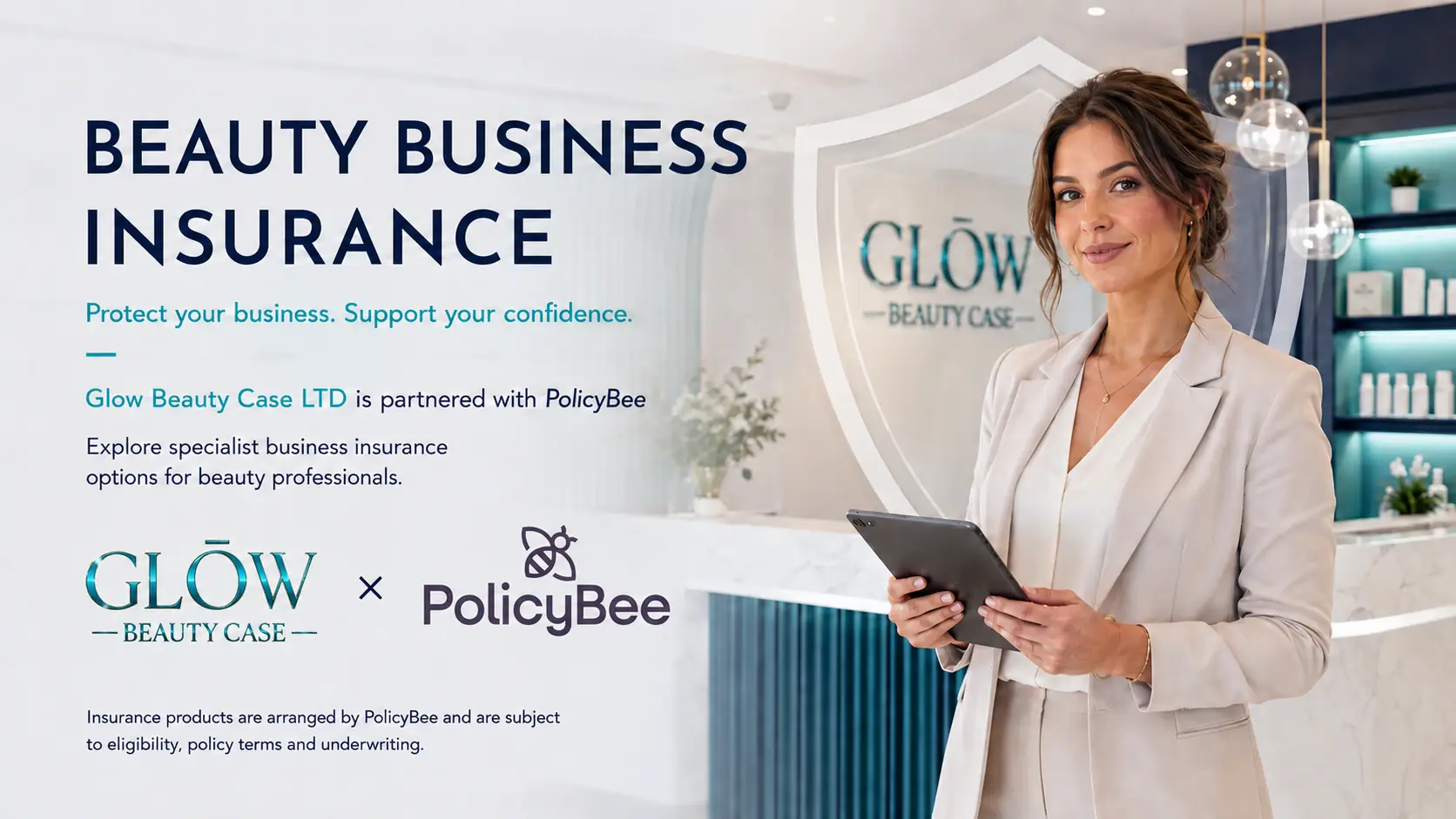
That is also why Glow Beauty Case has teamed up with PolicyBee, our recommended professional insurance broker for beauty and aesthetics businesses.
What is beauty insurance in the UK?
Beauty insurance is a broad term describing business insurance designed around the risks associated with providing professional beauty and aesthetic treatments.
A beauty therapist working independently from a treatment room may have very different requirements from a large salon employing several therapists. Likewise, an aesthetics clinic operating advanced equipment may have different risks from a mobile beauty professional carrying portable equipment between clients.
For this reason, there isn’t one universal beauty insurance policy that is automatically right for every UK practitioner.
Depending on the business and policy selected, relevant insurance can include:
- treatment liability or malpractice insurance
- public liability insurance
- employers’ liability insurance
- salon or clinic cover
- professional equipment insurance
- portable equipment insurance
- business interruption cover
- other business-specific protection
The important point is to insure the business you actually operate.
If you introduce a new treatment, purchase a new professional machine, employ somebody or change the way you work, your insurance requirements may also change.
Do beauty therapists need insurance in the UK?
There is an important distinction between insurance that is legally compulsory and insurance that may be commercially or professionally important.
Public liability insurance is not generally compulsory under UK law. However, beauty professionals regularly work directly with members of the public, either in salons and clinics or within clients’ homes, making public liability an important form of protection for many businesses.
Employers’ liability is different. If your business becomes an employer, UK rules generally require employers’ liability insurance, subject to limited exemptions.
Separate treatment or malpractice cover may also be extremely important for professionals performing treatments on clients.
The fact that a particular insurance policy is not universally required by law does not mean operating without it is commercially sensible.
Practitioners should also remember that insurers, landlords, professional bodies, training organisations or other organisations may have their own requirements.
What does beauty insurance UK cover?
The answer depends entirely on the policy.
This is why salon owners should avoid assuming that buying something described as “beauty insurance” automatically protects every aspect of their business.
One policy may focus primarily on treatment and public liability. Another may include salon contents. Equipment protection may be optional. Advanced aesthetic treatments may have specific qualification or eligibility requirements.
Always read the individual policy documentation and tell the insurer accurately what your business does.
Let’s look at some of the most important types of cover.
Treatment liability and malpractice insurance
Treatment liability — sometimes described as treatment malpractice or medical malpractice depending on the type of policy and activity — is particularly important within an industry where practitioners physically perform treatments on clients.
Even a highly experienced practitioner can face an allegation that a treatment caused injury, illness or another form of harm.
The financial impact of such a claim can extend far beyond compensation. Legal representation itself can become expensive.
Treatment or malpractice insurance is designed to respond to eligible claims arising from negligence or errors while carrying out covered treatments, subject to the terms and limits of the policy.
For practitioners offering advanced beauty and aesthetics treatments, it is particularly important to make sure the insurer knows exactly which treatments are being provided.
Don’t assume that because your policy covers professional facials, it automatically covers every machine-based facial technology you later introduce.
Public liability insurance for beauty salons and clinics
Public liability deals with a different category of risk.
Imagine a client enters your salon, catches their foot on a cable and falls. Or something belonging to a client is accidentally damaged while they are on your premises.
These are not necessarily treatment-related incidents.
Public liability insurance is designed to protect businesses against eligible third-party claims involving accidental injury or property damage arising from business activities.
For salons and clinics that regularly welcome members of the public onto their premises, it is easy to understand why this protection can be valuable.
Mobile beauty therapists should consider it too. Working inside somebody else’s home introduces a different environment and therefore different opportunities for accidental property damage or injury.
Employers’ liability insurance for beauty businesses
If your salon or clinic employs staff, employers’ liability insurance requires particular attention.
UK businesses that become employers are generally legally required to obtain employers’ liability insurance from an authorised insurer, subject to specific exemptions.
The required cover is generally at least £5 million.
This insurance is designed to help businesses meet eligible compensation costs where an employee becomes injured or ill because of the work they perform.
This is one area where salon owners should not simply assume that another liability policy covers the requirement.
If your business is growing and you’re taking on employees for the first time, check your obligations before they begin working.
Beauty equipment insurance
For machine-led salons and aesthetic clinics, equipment deserves its own consideration.
Professional treatment technology isn’t simply furniture sitting in a treatment room. It may be directly responsible for generating thousands of pounds of appointments.
If a key machine is stolen or damaged, the financial consequences can include:
cancelled appointments, lost treatment revenue, unhappy clients, refunds, rescheduling pressure and the cost of repairing or replacing the equipment itself.
This is why businesses researching beauty insurance UK should look carefully at whether equipment protection is included and exactly what it covers.
PolicyBee, for example, offers portable equipment cover for beauty professionals and also discusses clinic/equipment protection within its aesthetics insurance options.
But the exact insured events, limits, exclusions and conditions matter.
A policy covering theft or accidental damage is not automatically the same thing as an engineering warranty covering every mechanical or electrical fault.
Always check.
Don’t forget the value of handpieces and accessories
One mistake salons can make when assessing equipment value is concentrating entirely on the main machine.
Professional systems may also include valuable:
- treatment handpieces
- probes
- cartridges
- screens
- applicators
- accessories
- specialist attachments
- tablets or laptops used alongside the business
If you are arranging equipment insurance, establish whether these components are included and whether individual-item limits apply.
A machine may still be sitting perfectly safely in the clinic while one expensive handpiece becomes damaged.
Keeping an accurate equipment register can make this process much easier.
Create a professional salon equipment register
Every machine-led beauty or aesthetics business should consider maintaining an equipment register.
This doesn’t need to be complicated.
Record information such as:
- equipment name
- model
- serial number
- purchase date
- purchase price
- current replacement value where appropriate
- usual location
- relevant accessories
- maintenance or servicing history
Keep invoices and important documentation securely too.
This gives you a much clearer picture of the total value of equipment your business relies upon.
It can also help when reviewing insurance because you’re working from actual records rather than trying to remember what you’ve accumulated over several years.
Beauty insurance for advanced aesthetic treatments
The beauty and aesthetics industry now includes technologies far beyond traditional salon services.
Professional businesses may offer hydradermabrasion, ultrasonic cavitation, radio frequency, HIFU, RF microneedling, LED light therapy and other technology-led treatments.
Advanced treatments can create additional insurance considerations.
The insurer may want to know what treatment you provide, your qualifications and experience and other information relevant to its assessment of the risk.
PolicyBee specifically states that training and practical experience are relevant to eligibility for its non-medical aesthetics cover.
That is why we recommend checking insurance before launching a new treatment rather than after you’ve already started accepting bookings.
Does having a CE or UKCA marked machine automatically mean you’re insured?
No.
Equipment compliance and business insurance are separate considerations.
Professional equipment should have the documentation and conformity information applicable to that particular model and its intended use. However, this does not automatically provide insurance for the practitioner using it.
Likewise, having professional insurance does not replace practitioner training, appropriate equipment selection, consultation procedures, maintenance or responsible treatment protocols.
A professional treatment business should consider all of these areas together.
At Glow Beauty Case, our professional aesthetic equipment is supplied with model-specific compliance information, with models carrying CE, UKCA and/or RoHS documentation as applicable. Many of our current models now carry all three. Practitioners should check the individual product listing for the certification applicable to the specific machine they are considering.
Why training matters when arranging beauty insurance
Your insurance provider needs an accurate understanding of the treatments you provide and the professional background from which you provide them.
PolicyBee explains that when arranging beauty insurance, practitioners can be asked about the treatments they perform and the qualifications they hold.
This is important.
If you purchase a new machine and introduce a treatment that your insurer doesn’t know about, you should not simply assume your existing cover automatically extends to it.
The professional sequence should be:
Choose appropriate equipment → obtain appropriate training → check your insurance → establish your treatment protocols → begin treating clients.
That is a far stronger foundation than buying equipment on Monday and worrying about insurance after taking your first booking on Friday.
Glow Beauty Case has teamed up with PolicyBee
At Glow Beauty Case, we want to support professional customers beyond the point at which a machine arrives at their clinic.
That is why we have teamed up with PolicyBee, our recommended professional insurance broker for beauty and aesthetics businesses.
PolicyBee specialises in business insurance and provides dedicated options for beauty therapists and aesthetics practitioners.
For Glow Beauty Case customers, this provides a straightforward route to speak with an insurance specialist about your business, treatments, qualifications and equipment.
If you’re setting up a new salon, expanding an established aesthetics business or introducing new professional equipment, you can use the dedicated Glow Beauty Case PolicyBee route to explore your insurance options and obtain a quotation.
Insurance is arranged directly with PolicyBee and is not included with Glow Beauty Case equipment purchases.
Beauty insurance for mobile practitioners
Not every professional operates from a permanent salon.
Mobile therapists may travel between client homes, rent rooms within different salons or provide treatments at events.
This introduces another set of questions.
Is your equipment insured while away from your normal premises?
What happens if it is stolen?
What happens if you accidentally damage something inside a client’s home?
Does your policy cover every location in which you work?
PolicyBee offers portable equipment insurance options for beauty professionals, alongside treatment and public liability cover.
If you work across several locations, tell the insurer exactly how your business operates rather than purchasing cover based on the assumption that mobile work is automatically included.
What about beauty salon insurance for premises?
A salon or clinic itself represents another significant investment.
Furniture, treatment beds, reception equipment, stock, computers and professional treatment technology can collectively have a substantial replacement value.
Businesses operating from commercial premises should therefore consider what would happen following events such as fire, flood, theft or another insured incident.
The immediate damage is only one problem.
If the salon cannot open, revenue may stop while rent, wages and other overheads continue.
This is where conversations around salon/clinic cover and potentially business interruption insurance become relevant.
Again, the appropriate protection depends on the individual business.
Business interruption and machine-led clinics
Imagine your busiest professional machine becomes unavailable.
Perhaps you have dozens of appointments booked over the next month.
Even if the machine itself is eventually repaired or replaced, what happens to those bookings in the meantime?
Treatment-led clinics should think about business continuity as well as physical equipment value.
Can appointments be transferred to another machine?
Could you temporarily hire replacement equipment?
How much revenue could be lost?
Would clients wait or book elsewhere?
Insurance cannot eliminate operational disruption, but understanding the financial exposure allows you to discuss appropriate protection with your broker.
How much does beauty insurance cost in the UK?
There isn’t one universal price for beauty insurance UK businesses will pay.
Cost can depend on factors including:
- treatments provided
- practitioner qualifications
- turnover
- required cover limits
- equipment value
- number of employees
- premises
- optional covers
- individual insurer criteria
The cheapest policy is therefore not necessarily the best-value policy.
PolicyBee currently advertises beauty treatment and public liability insurance and separate portable-equipment options, while its aesthetics products have different cover structures and eligibility criteria.
Prices can change, so businesses should obtain a current personalised quotation rather than relying on an old figure from an article.
Why choosing insurance based only on price can be a mistake
Insurance is one area where saving a few pounds on the premium can prove expensive if you’ve sacrificed something important.
Look at the cover, not just the headline price.
Check:
- what treatments are included
- exclusions
- policy limits
- excesses
- equipment limits
- portable equipment requirements
- territorial limits
- qualification requirements
- business activities declared
- claims conditions
If anything isn’t clear, ask.
It is far better to spend ten minutes asking a question before buying the policy than discover the answer after something has happened.
Review your beauty insurance when your business changes
Insurance should not be something you arrange when opening the business and then forget about indefinitely.
Beauty businesses evolve quickly.
You may purchase another £3,000 of equipment, introduce a new treatment, employ another practitioner, move premises, start offering mobile treatments or substantially increase turnover.
Any of those changes may affect your insurance needs.
Consider reviewing your arrangements whenever there is a significant change to the business and at renewal.
Your equipment register makes this easier because you can immediately see whether the value of your professional technology has increased.
Beauty insurance and professional clinic standards
Good insurance should sit alongside good operational standards.
Professional salons and aesthetic clinics should have appropriate systems for areas such as:
- client consultation
- contraindication checking
- treatment records
- practitioner training
- hygiene
- equipment maintenance
- aftercare
- incident reporting
- equipment documentation
Insurance doesn’t replace any of these.
Instead, they collectively form the professional infrastructure surrounding the treatments you provide.
That distinction matters particularly as beauty businesses introduce increasingly sophisticated professional technology.
Why Glow Beauty Case recommends PolicyBee
We have teamed up with PolicyBee because professional beauty and aesthetics businesses need more than professional equipment.
They need the confidence to build businesses around that equipment.
PolicyBee provides dedicated insurance options for beauty therapists and aesthetics practitioners, including treatment/malpractice and public liability cover, with additional equipment and clinic protection available depending on individual requirements.
They also understand that practitioner qualifications and treatment activities matter when arranging appropriate insurance.
That makes PolicyBee particularly relevant to Glow Beauty Case customers investing in professional technology and developing more advanced treatment menus.
Speak directly with PolicyBee about your circumstances and obtain a personalised quotation before relying on any insurance for your business.
Insurance eligibility, cover limits, exclusions, treatment acceptance and policy conditions are determined by PolicyBee and the relevant insurer.
Beauty insurance UK: questions to ask before buying
Before taking out or renewing a policy, ask yourself:
Are all of my current treatments declared?
If you’ve added services since taking out the policy, check them.
Does my training meet the insurer’s requirements?
Don’t assume completing any course automatically satisfies every insurer.
Is my equipment properly valued?
Calculate the replacement value of your professional machines and important accessories.
Does the policy cover equipment away from the salon?
Particularly important for mobile practitioners.
Do I employ anyone?
If so, check your employers’ liability obligations.
What is my excess?
Know what you would need to contribute towards a claim.
Are there individual equipment limits?
One expensive machine may exceed a standard contents limit.
What isn’t covered?
Exclusions are just as important as the list of benefits.
What happens if I add another treatment?
Know how to update the insurer.
Who do I contact if something happens?
Keep claims information somewhere accessible.
Protect the business behind the treatments
The UK beauty and aesthetics industry is increasingly professional, technology-led and commercially sophisticated.
A treatment room can now contain thousands — sometimes tens of thousands — of pounds of specialist equipment.
But the greatest asset is the business built around it.
Your reputation. Your clients. Your practitioners. Your bookings. Your treatment knowledge. Your premises. Your future revenue.
The right beauty insurance UK policy should therefore be considered part of your professional business infrastructure rather than another administrative expense.
Choose professional equipment carefully. Train appropriately. Maintain good records. Follow responsible treatment protocols. Keep your insurer informed as your business develops.
And make sure the insurance you purchase actually reflects the business you operate today — not the business you operated two years ago.
Glow Beauty Case has teamed up with PolicyBee to give beauty and aesthetics professionals direct access to a specialist business insurance broker that understands the sector.
Whether you’re opening your first treatment room, investing in your next professional beauty machine or developing an established aesthetics clinic, protecting the business behind that investment deserves the same attention as choosing the equipment itself.
Professional equipment helps you build your treatment menu.
Professional training helps you deliver it.
Professional insurance helps protect what you have built.
Glow Beauty Case × PolicyBee — professional equipment and professional protection for beauty and aesthetics businesses.
Insurance is not included with Glow Beauty Case orders. Customers must contact PolicyBee directly to obtain an individual quotation. Cover is subject to eligibility, policy terms, conditions, limits and exclusions. Always confirm that your individual treatments and business activities are covered before treating clients.